- Think of a few songs you really like - current, classic rock, whatever - as long as there are lyrics!
- Do an internet search for the lyrics. Choose one song to use.
- Copy the lyrics into a new post on your blog.
- Open up this document. Complete the chart based on the lyrics for your song.
- In the same blog post as the lyrics, write a rhetorical analysis of the song! What are the different rhetorical techniques the song uses? What is their effect on the feel and meaning of the song? Based on this look at the language, what are you now noticing in the song that you might have missed the first time around?
- When you are done, spend some time reading what songs other people put onto their blogs, and feel free to comment.
- *Something cool - if you want to insert a YouTube clip of your song into your post, us the little movie clapboard icon - it's right up there two to the right of "link" - that way we can listen to your song while reading what you had to say about it!
Wednesday, December 18, 2013
Syntax and pop songs
It's time to look at the lyrics of some of your favorite songs!

Thursday, December 12, 2013
Short short stories
Today you will be working with a small group or partner. Read the story I assigned to your group, and take a few minutes to discuss it. Try to get a sense of what the story is about, and what some potential layers of meaning are.
Then, you will work together to form an analysis of the syntax of the story:
story 1
story 2
story 3
story 4
story 5
story 6
Then, you will work together to form an analysis of the syntax of the story:
- How does the author use sentence lengths? Are they varied or similar throughout the story? Why? What is the effect of these types of sentences?
- How does the author use different types of sentences: imperative, interrogative, exclamatory, or declarative? Why? What is the effect of these types of sentences?
- Does the author use repetition, either of words or images? Why? What is the effect?
- What other techniques does the author use? How is this story told?
- Overall, what is the story about, and how does the construction of the syntax of the story help convey that meaning?
Put your answers in a blog post on the blog of one person in your group.
We will share these at the end of class.
story 1
story 2
story 3
story 4
story 5
story 6
Tuesday, December 10, 2013
New tool - Socrative
We'll start today by heading over to Socrative.com
Click 'sign in as student' then go to my classroom: 856036
I'll take it from there!

Click 'sign in as student' then go to my classroom: 856036
I'll take it from there!

Wednesday, December 4, 2013
Syntax - analyzing a story
Greetings!
I will not be in class today - I had to leave school early to go to a conference in New York.
Today you will be trying out some analysis using the ideas about syntax I introduced yesterday. Here again is a link to the handout with an overview of what syntax means: Syntax handout
Take a few minutes to review it.
Next you will be reading a short story by Edgar Allan Poe: The Tell-Tale Heart (at the end of the file there is an instruction to write an essay - do not write that one - instead, write the one below)
While you are reading it, look for these aspects of syntax:
I will not be in class today - I had to leave school early to go to a conference in New York.
Today you will be trying out some analysis using the ideas about syntax I introduced yesterday. Here again is a link to the handout with an overview of what syntax means: Syntax handout
Take a few minutes to review it.
Next you will be reading a short story by Edgar Allan Poe: The Tell-Tale Heart (at the end of the file there is an instruction to write an essay - do not write that one - instead, write the one below)
While you are reading it, look for these aspects of syntax:
- Sentence Length - when is Poe using short (5 -10 words), medium (10 - 15 words), or long sentences (15+ words)? What is the effect of these different sentence lengths?
- Sentence Structures - when is Poe using repetition, or other forms that aren't typical?
- Different types of sentences: When does Poe use these?
- Declarative = makes a statement. EX: The king is sick.
- Imperative = gives a command. EX: Bow to the king.
- Interrogative = asks a question. EX: What’s the matter with the king?
- Exclamatory = makes an exclamation. The king is dead!
In a document on Google Drive that you share with me, write an analysis of the syntax of "The Tell-Tale Heart." Which different types of sentences does Poe use in the story? How do they affect your thoughts and feelings about the story and what happens in it? What effect do these different types of sentences have on the meaning of the story? Your essay should be 1-2 paragraphs - about a page of writing. Make sure to refer to specific parts of the story in your analysis, using quotations where they help make your point.
Syntax - telling a story
Crazy things always happened when Ray was the driver back in high school. One night we were heading to the mall - or maybe we were coming home. We had to drive a lot of back roads in order to get there - past farms and fields. The roads were dark but we knew them well. There was one area where the road makes a sudden left then right - a big S curve out in the corn fields. Ray of course knew it was coming but started to drive faster. We started screaming. "Ray! What are you doing!? Slow down!" Ray started laughing maniacally, widening his eyes, waving his head back and forth like a man possessed. We kept screaming. Ray kept driving faster. Just as we got to the turn, we braced for what we were sure was going to be the car flipping over. Instead, Ray drove straight. At full speed. Into the corn field. We plowed over corn stalks, Ray laughing hysterically, before finally coming to a stop. Moments earlier we were sure we were going to die, but now we all got out of the car and stood looking at the road off in the distance, and a the flattened path of corn behind the car.
Syntax
Greetings!
Today we'll start a new point of focus: syntax.
What is it? What does it mean?
We started today by telling some stories - emotional stories.
After we hear a few, think about how they told the story - what types of sentences did they use?
Were they:
Next we'll look at this sheet to help us think about those stories and how they are structured: Syntax handout
Today we'll start a new point of focus: syntax.
What is it? What does it mean?
We started today by telling some stories - emotional stories.
After we hear a few, think about how they told the story - what types of sentences did they use?
Were they:
- slow and deliberate
- fragmented and incomplete
- rushed and disorganized
- very long and uninterrupted
- a steady, walking pace
- hesitant; starting and stopping
- brief and abrupt
Next we'll look at this sheet to help us think about those stories and how they are structured: Syntax handout
Saturday, November 23, 2013
Wednesday, November 20, 2013
Thanksgiving - what do you think?
With Thanksgiving right around the corner, many people have wondered about what this holiday means, how it should be celebrated, and whether there needs to be changes in traditions or not. To get us thinking about it, please read this article: Thanksgiving article
Then, to give us one last opportunity to think about pathos, ethos, and logos, you will respond to the article by writing a post on your blog. What do you think about Thanksgiving? How would you like to see it celebrated, if at all? Make your argument using all three forms of persuasion.
If you need to remind yourself about pathos, ethos, and logos, click here
Then, to give us one last opportunity to think about pathos, ethos, and logos, you will respond to the article by writing a post on your blog. What do you think about Thanksgiving? How would you like to see it celebrated, if at all? Make your argument using all three forms of persuasion.
If you need to remind yourself about pathos, ethos, and logos, click here
Thursday, November 14, 2013
Making Videos with Popcorn Maker - Round 2
Yesterday was play time, experimenting around with this fun web movie-making tool.
Today we'll show the films you made - the ones that were successfully saved - as well as a look at the techniques you used.
Then we'll get into groups:
Today we'll show the films you made - the ones that were successfully saved - as well as a look at the techniques you used.
Then we'll get into groups:
- Jacob, Brenden, Zoe, Stella
- Josh, Caroline, Eve, Nikki
- Lucas, Maggie, Jordan, Theodora
- Zach, Matt, Izzy, Jackie
Here is the task for today - to use Popcorn Maker to create a look at Pathos, Ethos, and Logos in three commercials.
- Have someone sign in to Popcorn Maker.
- Start a new project - save it as soon as possible, making sure you give it a name. (We found out the hard way yesterday that you need to sign in first and save early - several people lost work!)
- Find three commercials you want to work with today. They should be for different things - one of them must be for a service, and the others for products. Feel free to use whatever you'd like here - recent stuff, classical, foreign, whatever.
- Watch them together with your group and note where the ads are using pathos, ethos, and logos.
- Put these three ads into your project and then find a fun way to add in ways of identifying the pathos, ethos, and logos (of course they might not all be present in each commercial). It can simply be with pop-up dialogue boxes, and there is still a lot of creative room to use there. Or you can add in whatever else you think would help your audience to see these factors.
- Try to finish this with about 10 minutes left in the period so we can watch them!
Ethos – Pathos –
Logos
Ethos
·
Before
you can convince an audience to accept anything you say, they have to accept
you as credible.
·
There
are many aspects to building your credibility:
o Does the audience respect
you?
o Does the audience believe you
are of good character?
o Does the audience believe you
are generally trustworthy?
o Does the audience believe you
are an authority on this speech topic?
·
Keep
in mind that it isn’t enough for you to know that you are a credible
source. (This isn’t about your confidence, experience, or expertise.)
Your audience must know this. Ethos is your level of credibility as perceived
by your audience.
·
How
to build ethos
o Show expertise
o Show shared experiences with
audience
o Use language familiar to your
audience
o Quote known sources
o Reference people in the
audience
Pathos
·
Pathos
is the quality of a persuasive presentation which appeals to the emotions of
the audience.
o Do your words evoke feelings
of … love? … sympathy? … fear?
o Do your visuals evoke
feelings of compassion? … envy?
o Does your characterization of
the competition evoke feelings of hate? contempt?
·
Emotional
connection can be created in many ways by a speaker, perhaps most notably by stories.
The goal of a story, anecdote, analogy, simile, and metaphor is often to link
an aspect of our primary message with a triggered emotional response from the
audience.
·
How
to build a sense of pathos
o Choose an theme / emphasis
o Choose words to build onto
this theme
o Tell stories
o Use humor
o Work on having delivery match
the emotions you are projecting
Logos
·
Logos
is synonymous with a logical argument.
o Does your message make sense?
o Is your message based on
facts, statistics, and evidence?
o Will your call-to-action lead
to the desired outcome that you promise?
·
How
to be sure your audience follows the logic:
o Use plain language
o Be explicit
o Use comparisons, analogies,
or metaphors
o Ask questions – get the
audience thinking
o Note the other side and
refute it
o Emphasize the points most
valuable to the audience
Wednesday, November 13, 2013
Making Videos with Popcorn Maker
Today we will play around with a fun web tool - Popcorn Maker.
You can find it here: https://popcorn.webmaker.org/en-US
I'm going to give you a quick look at it, then let you go play for the period.
We will use this tool to create videos connecting to our work on Pathos, Ethos, and Logos, but for today we'll just explore the tool to see what it can do.
Here's one I've just started working on:
https://mrrigler.makes.org/popcorn/1k1j
You can find it here: https://popcorn.webmaker.org/en-US
I'm going to give you a quick look at it, then let you go play for the period.
We will use this tool to create videos connecting to our work on Pathos, Ethos, and Logos, but for today we'll just explore the tool to see what it can do.
Here's one I've just started working on:
https://mrrigler.makes.org/popcorn/1k1j
Thursday, November 7, 2013
Racial Diversity on Television - Part 2
Last time we discussed the recent Saturday Night Live controversy about the lack of black women in the cast. Our work today will continue that conversation by bringing other voices into the mix.
You will research an article about issues of race, diversity, and television. Once you find it, you will read it, and then write a blog post including these elements:
You will research an article about issues of race, diversity, and television. Once you find it, you will read it, and then write a blog post including these elements:
- An analysis of the person's argument in terms of ethos, logos, and pathos. What claims are they making? How are they presenting their argument?
- Your response. Do you agree or disagree with this person's claims? Do you react differently to various parts of their argument? Why?
We'll take about 30 minutes for this. When you are done we will turn to a discussion once again to share these new perspectives and our evolving thoughts.
Tuesday, November 5, 2013
Diversity in Television
Here are some resources for our look at the recent Saturday Night Live controversy about the absence of Black women in the cast.
Interview with Kenan Thompson from TV Guide
NY Times article on SNL cast diversity
NYTimes: "Broadcasting a World of Whiteness"
Video: NY Times article
SNL Videos
Interview with Kenan Thompson from TV Guide
NY Times article on SNL cast diversity
NYTimes: "Broadcasting a World of Whiteness"
Video: NY Times article
SNL Videos
Wednesday, October 30, 2013
Ethos Pathos Logos - Continued
As we continue to explore these ideas, the world of advertising has given us a lot to think about. In class today we were talking about the Old Spice commercials and I found this insightful analysis of them:
http://codio001.wordpress.com/2012/01/26/old-spice-rhetorical-analysis/
http://codio001.wordpress.com/2012/01/26/old-spice-rhetorical-analysis/
Thursday, October 24, 2013
Logos - the appeal to Logic
Today we'll watch the presentation we created yesterday, looking at the ways in which advertisements use logic as part of their appeal.
Before we do that, please read these two documents:
Before we do that, please read these two documents:
- Logos - Appeal to Logic
- Purdue University's OWL Writing Center - Rhetorical Strategies for Persuasion
- scroll down to "Avoid Logical Fallacies" and read that list
When we are finished going through the presentation, which we do somewhat quickly, you'll return to one of the ads - it can be one you already worked with, one you saw in another presentation, or a new one you want to work with today.
In a new post on your blog, paste the ad and break down the ways in which it uses Logos in its message. Is it successful? Are there particular strengths, as noted in the first handout? Are there places where there are logical fallacies, as noted on the Purdue list? In a paragraph analysis, choose two (one or two fallacies; one or two effective, truthful claims) to describe in detail. How does the ad convey this? Then, in a final statement, do you think the argument is ultimately effective, even if it has flaws?
Wednesday, October 23, 2013
Logos and Advertising
Today we will be discussing the idea of Logos - the appeal to logic. This happens when a character, or in our work today, a company, wants to convince another person of a key idea. In the examples we'll look at today, that will take the form of convincing a person to buy a product or service.
Here's how we'll do it.
Here's how we'll do it.
- Look through these web sites and select three advertisements you want to work with today.
- http://webdesignledger.com/inspiration/45-advertisements-you-will-never-forget
- http://www.hongkiat.com/blog/70-creative-advertisements-that-makes-you-look-twice/
- Any other advertisement from any source you want to work with.
- For each of the three advertisements you will write a syllogism - an argument consisting of a major premise, a minor premise, and a conclusion. See the example in the presentation referenced below. Your should follow this formula: because this is true (insert evidence from the ad) and because this is true (add a second piece of evidence or idea), you should do this / buy this.
- You will add your work to a shared Google Presentation, which I have invited you to join. You should paste the image of your ad on one slide by itself, then on the next slide add the syllogism you created. Do this three separate times - one for each ad.
Wednesday, October 9, 2013
Point of View and Fairy Tales II - Stories from across the world
Today you will once again work with your same partner as last week.
This time you will return to the same website to explore fairy tales from other cultures and traditions.
http://www.worldoftales.com/
You and your partner will start by looking at tales from these traditions:
This time you will return to the same website to explore fairy tales from other cultures and traditions.
http://www.worldoftales.com/
You and your partner will start by looking at tales from these traditions:
- Ryan and Stella - African - Nigerian
- Jacob and Jackie - African - South African
- Maggie and Josh - African - Tanzanian
- Lucas and Caroline - Asian - Arabic
- Nikki and Matt - Asian - Chinese
- Brenden and Isabel - Asian - Indian
- Zoe and Zach - Asian - Japanese
- Jordan and Theodora - South American - Brazilian
You will choose two tales from your list to work with today.
Again you will work with either a Google Presentation or a Prezi format - up to you (and if there is another program you want to use, let me know!).
First, you will tell the story as it exists. Add in images and make edits if it is a long story, but the goal with this step is to tell the story true to its original state.
Next you will re-tell the story from an "American" perspective, however you want to interpret that. In order to make that happen, you will first want to talk about the differences between the culture and tradition represented in the original story and the ways in which it would be different if it were set in the United States. Then, think about where you want to situate that story here - is it in the North Shore? In DHS? In Chicago? In some other part of the country?
Lastly, you will include a slide that comments on the similarities and differences between the cultures and aspects of these two versions of the story. What changes did you need to make? Why? What does one culture value differently than the other? What does one culture include in its stories that are hard to imagine in the other?
We'll hopefully share these at the end of class tomorrow.
Enjoy!
Wednesday, October 2, 2013
Point of View and Fairy Tales
Today you will be working with an assigned partner, listed below:
You will be choosing a fairy tale, creating a short Google Presentation or Prezi about it, then adding in another version of the story, told from a different perspective.
- Ryan and Stella - Sleeping Beauty
- Jacob and Jackie - Rapunzel
- Maggie and Josh - The Pink
- Lucas and Caroline -
- Nikki and Matt - Rumplestiltskin
- Brenden and Isabel - Snow White
- Zoe and Zach -
- Jordan and Theodora - Cinderella
You will be choosing a fairy tale, creating a short Google Presentation or Prezi about it, then adding in another version of the story, told from a different perspective.
- Start by going to this website which links to full text versions of a wide variety of fairy tales, from popular Grimm ones to others from various cultures around the world: World of Fairy Tales
- Choose a fairy tale to work with and read it together.
- Think about what other potential perspectives there are in the story (other characters or objects named in the story, factors present but not explicitly named). Select at least one to work with today.
- Create a version of the story told from this new perspective - use as many specific details from the original story as you can, but also work to be creative about what you can potentially add.
- Create your Google Presentation or Prezi, based on your comfort with the software. If you have not tried Prezi, I recommend giving it a whirl. My guess is you'll quickly be able to figure out the basics.
- Share your presentation with me and post it to both of your blogs. You'll have today and tomorrow to work on it, and hopefully with the second half of tomorrow we'll be able to share them!
Thursday, September 26, 2013
Visual Literacy
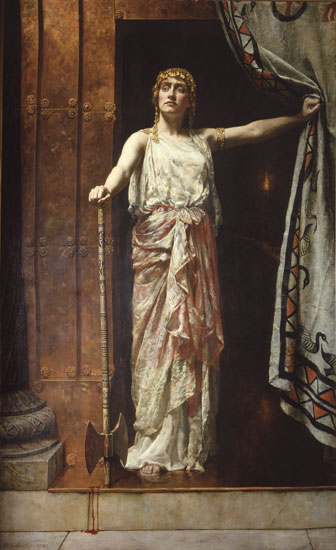
Here is John Collier's "Clytemnestra, After Murdering Agamemnon." Spend some time looking at the painting and consider these questions:
- What is the tone of the picture?
- What aspects enhance the tone?
Next you'll choose one of the images below to examine in a blog post of your own:
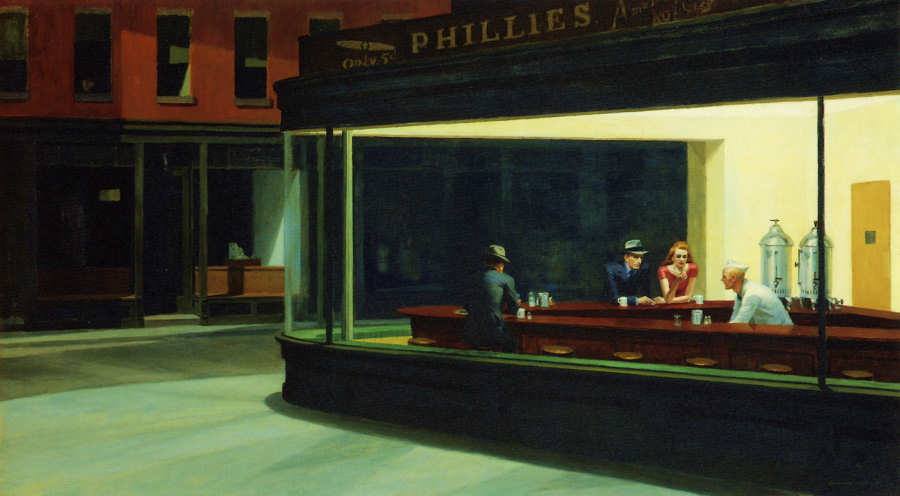
Edward Hopper's "Nighthawks at the Diner"

Grant Wood's "American Gothic"

Archibald Motley's "Nightlife"

Diego Rivera's "The Flower Carrier"

Georgia O'Keeffe's "Ram's Head White Hollyhock and Little Hills"
Wednesday, September 18, 2013
Cyber Bullying
We'll start today by reading this article from the New York Times about a recent suicide related to cyber-bullying.
We'll have a short discussion about it then do some writing in the comments section of this blog, responding to it with different tones and points of view.
Perspectives:
We'll have a short discussion about it then do some writing in the comments section of this blog, responding to it with different tones and points of view.
Perspectives:
- Mother
- Classmates - non-bullies
- Classmates - bullies
- Technology
- Police
- Principal
- Girl
- Sympathetic / Understanding
- Disconnected
- Anger
- Sadness
- Confusion
Thursday, September 12, 2013
A look at the anniversary of 9-11
Please go visit this website.
Down the left-hand side is a list of newspapers and magazines. Select a few of these and browse around to find their coverage of the 9-11 anniversary.
Select an article you'd like to read and then read it.
Back on your blog, create a new post including:
Down the left-hand side is a list of newspapers and magazines. Select a few of these and browse around to find their coverage of the 9-11 anniversary.
Select an article you'd like to read and then read it.
Back on your blog, create a new post including:
- a link to the article
- your commentary on it (a short paragraph)
Wednesday, September 11, 2013
Let's Blog!
Let's Blog!!
Blogging
Today you will all become part of what has become known as the blogosphere, a modern day adaptation of the public square. In a tradition that has its roots in early American society, the public comes together to explore the interesting and provocative ideas of the day. In 2013, that universe has expanded to allow anyone's ideas to be put into the marketplace for the world to see or hear. Today, you will set up your blog that will allow you to do just that.
What is a blog?
What does a blog look like?
Let’s make a blog! (Note-first step will to be to sign in to Google).
Some things to consider-
- Choosing a design
- Including gadgets
- Warnings before going too far
- Audience
- Privacy - no full names, personal information
- Expectations - tone, respect, acceptable topics
- Writing posts
- Commenting on posts
- Incorporating images, video, links
Need help?
So, here are your ultimate tasks for today:
- Think of a catchy title. Make sure you add a description of what you want your blog to be or to express.
- E-mail Mr. Rigler with the name of your blog and its URL address. He will create a link to it on the class blog.
- Write your first post. The first can be about virtually anything-current events, a good movie you’ve seen recently, the first day of school, etc. Spend some time with this. It will be the first time for your followers to get to know you and your ideas thus you want them to have a good sense of your voice.
- Comment on someone else's post.
Thursday, August 29, 2013
President Obama Commemorates Dr. King's Speech
Yesterday was the 50th anniversary of the March on Washington and Dr. Martin Luther King Jr.'s "I Have A Dream" speech. We read an article about the original march and the plans for the celebration. Here is a link to the speech President Obama delivered at yesterday's commemoration. Read the speech then post a comment. In it you should name what you consider to be President Obama's key point(s), followed by your personal reflections on them.
Then, read this editorial from today's New York Times. Post a short response to this piece - did it alter your opinion of President Obama's remarks? Give you a different perspective or raise something you hadn't previously considered? Did you agree or disagree with its points?
Then, read this editorial from today's New York Times. Post a short response to this piece - did it alter your opinion of President Obama's remarks? Give you a different perspective or raise something you hadn't previously considered? Did you agree or disagree with its points?
Wednesday, August 28, 2013
Tuesday, August 27, 2013
Subscribe to:
Comments (Atom)